A PEM electrolyzer project budget should show what is included, what is missing and which figures are still assumptions. Begin with the required gas duty and installation boundary. Keep the equipment quotation separate from site work and annual operating estimates.
This planning worksheet contains no market-price forecast or standard project cost. Project-specific estimates need current quotations and review by the responsible technical and commercial teams.
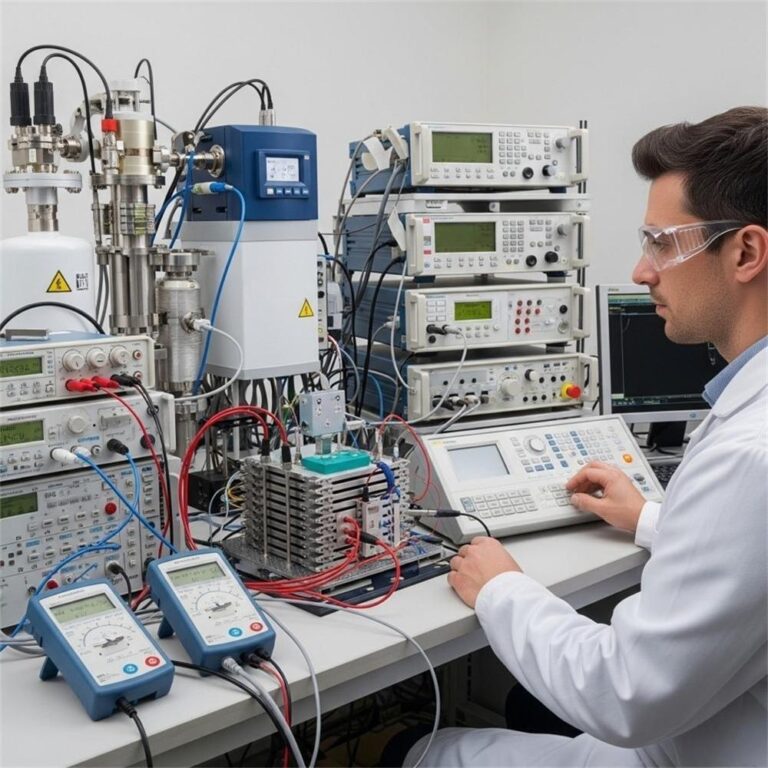
Cover illustration: conceptual scene; configuration varies by project.
1. Define the budget case
Record application, destination, hydrogen output, reference conditions, gas quality, delivery pressure, operating profile and intended installation. Decide whether the budget covers a stack integration, a complete generator or a larger hydrogen facility.
Give the budget a revision, currency, date and owner. Where the scope is undecided, show separate cases instead of combining uncertain options into one apparently precise total.
2. Use a cost register with evidence
| Budget line | Scope to identify | Evidence or open assumption |
|---|---|---|
| Core equipment | Stack or generator and included auxiliaries | Dated supplier offer and equipment list |
| Integration | Power, water, cooling, gas handling and controls outside the package | Integrator estimate with defined interfaces |
| Site preparation | Location-specific installation and utility work | Site survey and qualified contractor estimate |
| Delivery and handover | Packing, transport, installation support, testing and training | Allocated responsibilities and quotations |
| Operating inputs | Electricity, water, maintenance and consumables | Operating profile and model-specific information |
| Replacements and spares | Required service items and compatibility | Supplier information and agreed planning basis |
| Uncertainty allowance | Unresolved scope and estimating uncertainty | Named risk, basis and responsible owner |
3. Prevent omissions and double counting
Link each cost line to an equipment or responsibility item. If a quoted generator already includes a rectifier or gas-treatment stage, do not add the same item again without a reason. If the quote excludes cooling or downstream compression, show the missing scope and seek an estimate.
The DOE Water Electrolyzer Installations Summary Report highlights how installation design and assumptions affect project cost comparisons. Use local project evidence for your own site rather than copying a published project total.
4. Separate annual use from rated capacity
Estimate hydrogen demand from the intended operating schedule. Use energy information with a defined stack or system boundary and operating point. Record which external services remain outside the supplier’s figure.
Replacement intervals and maintenance costs need a stated equipment and duty basis. Where evidence is incomplete, use an explicit planning assumption and show how the result changes; do not turn that assumption into a product guarantee.
5. Record estimate maturity and next decisions
Mark each value as a supplier quotation, contractor estimate, internal assumption or unresolved item. Add validity dates and decision owners. Review the budget when the configuration, site, schedule or utility assumptions change.
Use the quotation comparison worksheet for competing equipment offers and the supply-scope matrix for installation boundaries. Review the PEM system range when selecting the equipment case.
Request the equipment inputs for your project budget
Send your company, project stage, destination, required gas duty, operating schedule, site utilities and proposed supply boundary. List the budget lines for which you need an equipment quotation or technical clarification.
Published by Hele Titanium Hydrogen. Updated 17 October 2026. This worksheet is a planning method, not a product quotation or a guarantee of project economics.