
PEM SYSTEMS / PROJECT SUPPLY
PEM Electrolyzer Systems
On-site hydrogen generation, built around your process.
Compare compact, industrial and modular PEM systems by hydrogen demand, site utilities and integration scope. Start with the operating requirement, then define the equipment package.

0.01–300
4 series
Project-specific
PURPOSE & VALUE
Start with the application.
On-site hydrogen generation, built around your process.
A complete PEM electrolyzer system combines the electrochemical stack with the equipment needed to deliver hydrogen to an agreed boundary. Water treatment, power conversion, cooling, gas conditioning and controls can materially change the project scope. Hele Titanium Hydrogen supports configuration discussions around the actual process, rather than flow rate alone.
A capacity range for different project scales
Compare lower-flow compact systems with industrial skid and modular arrangements. Series ranges guide selection; the proposal identifies the actual model and rated operating point.
A defined equipment boundary
Review the stack, power supply, water loop, separation, drying, cooling and controls as one package. Identify every purchaser-supplied utility and downstream subsystem.
Ready for engineering review
Build the project specification around purity, delivery pressure, operating hours, power profile and acceptance criteria. Keep assumptions visible from quotation to handover.
PROCESS & INTEGRATION
Understand the equipment pathway.
RANGE & CONFIGURATION
Compare the reference product families.
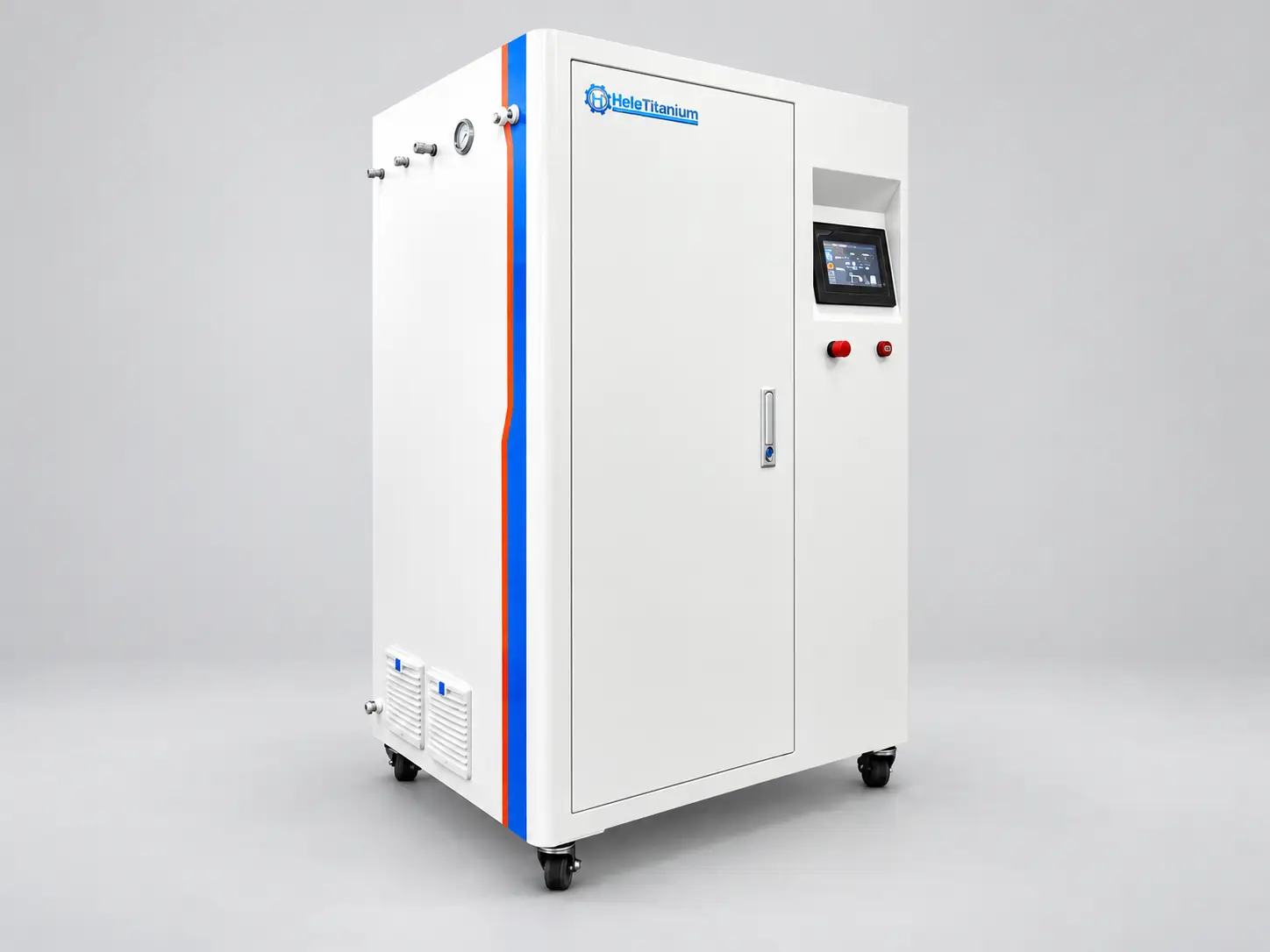
S-Series Compact Systems
0.01–1 Nm³/h
Compact reference family for low-demand laboratory and pilot applications.

H-Series Integrated Systems
1–10 Nm³/h
Mid-range reference family; define gas treatment, controls and utilities.

C-Series Industrial Systems
10–50 Nm³/h
Industrial skid reference family for process integration.

M-Series Modular Systems
50–300 Nm³/h
Project-scale family range; confirm the specific offered model and scope.

Containerized Systems
Project configuration
An enclosure and integration arrangement specified around the project duty.
TECHNICAL DETAILS
Define the engineering specification.
Reference data for configuration review. The accepted quotation and approved technical specification define the supplied equipment.
| Control | Order definition | Evidence when included |
|---|---|---|
|
Hydrogen duty |
Normal/peak output, operating hours, turndown, ramp, starts/stops and availability |
Sizing sheet and order-specific performance/FAT basis |
|
Electrical |
AC input or DC boundary, rated power/current/voltage, rectifier and auxiliary loads |
Electrical drawings and measured FAT data |
|
Gas delivery |
Pressure and measurement point, purity, dew point, separator/dryer/purifier and downstream boundary |
Defined sampling and analytical method |
|
Water & thermal |
Feed treatment, water-quality limits, consumption, circulation, temperature and cooling duty |
P&ID, water specification and operating/manual limits |
|
BoP & controls |
Pumps, separators, heat exchangers, valves, instruments, PLC/HMI, communications and alarms |
I/O list, cause-and-effect and functional test |
|
Safety & documents |
Relief/vent, detection, ventilation, shutdown, applicable standards, manuals and data book |
Approved safety/FAT/document package |
Configuration note. Family ranges are selection references. Confirm the exact model, rated conditions, auxiliary equipment, delivery boundary and acceptance criteria in the project quotation.
APPLICATIONS
Where this configuration fits.
Industrial process supply
Continuous or scheduled hydrogen consumption for a defined production process.
Renewable hydrogen
Power-profile assessment, operating-envelope review and storage coordination.
Pilot and demonstration plants
A clearly documented system boundary for staged technical evaluation.
BEFORE YOU REQUEST A QUOTE
Prepare a useful equipment brief.
01 / Hydrogen duty
Normal and peak output, purity, pressure and operating schedule
02 / Site utilities
Supply voltage, water quality, cooling and ambient conditions
03 / Plant integration
Control interface, downstream equipment and storage responsibility
04 / Acceptance
Test conditions, documentation, witness points and target delivery
BUYER QUESTIONS
Questions before specification.
Does the range mean every capacity is a stocked standard model?
No. The range describes published product families. Confirm the exact model, configuration, availability and lead time in the quotation.
Does a complete system include hydrogen compression and storage?
Only when those items are explicitly included in the scope. Specify the required delivery pressure and storage arrangement before comparing offers.
Which energy-consumption figure should I request?
Request complete-system AC consumption at a stated operating point and identify included auxiliaries. Keep stack DC data separate.
Can the system operate with renewable power?
Submit the available-power profile, control requirements and hydrogen demand. The engineering review must establish a suitable operating envelope and electrical architecture.
NEXT STEP / CONFIGURATION REVIEW
Tell us what the equipment needs to do.
Send your application, destination country and technical requirements. Include the delivery target and any drawings or procurement specification so the proposed scope can be reviewed against your project.
Please name the product family in your enquiry. Final technical values, documentation and delivery terms belong in the approved quotation.
Your enquiry checklist
- Hydrogen duty: Normal and peak output, purity, pressure and operating schedule
- Site utilities: Supply voltage, water quality, cooling and ambient conditions
- Plant integration: Control interface, downstream equipment and storage responsibility
- Acceptance: Test conditions, documentation, witness points and target delivery
RELATED EQUIPMENT